Author: Ann Jem

  • English breakfast recipe

    Serving suggestion

    As a new arrival to the UK, I was naturally delighted to try my hand at making an English breakfast. I was particularly excited to find out that everything in the classic combination might include microplastics, and I could be ingesting as much as a credit card per day! In fact, my kitchen apron is a cotton-polyester blend, so if I wash it it would shed microfibers into the water supply that then go into animals and agricultural soil. Did you know synthetic fabrics shed up to 500,000 tons of microplastics into the ocean every year? Those plastics then end up on our dinner plates and in our bloodstreams. It’s so cool to find out where my food comes from!

    I’m sure you guys want to get right to the good stuff, so here’s my take on a recipe for a classic English breakfast, which includes buttered toast, bacon, sausages, mushrooms, and an apple for a healthy snack. And of course, no English breakfast would be complete without a cup of tea (especially since teabags are one of the biggest contributors to microplastics in hot drinks). I hope you enjoy!

    Hot tip: Synthetic fabrics are made by melting down plastics, extruding them into fibers, and knitting them together. So by shredding and weaving your ingredients, it’s just like the traditional way to make a microplastic meal — and it’s so much easier to do at home!

    Please give the recipe 5 stars if you liked it, and follow me on Instagram or TikTok for more recipes!

    Cooking time: 5 hours (1.5 hour drying time) • Serves 1–2 people

    Ingredients

    • Kitchen debris:
      • 1 Tesco receipt (other supermarkets are also fine)
      • 1 orange juice label
      • 1 cotton/spandex blend jeans
      • 1 can of ground coffee
      • 1 piece of vinyl “wood” veneer
      • Other assorted debris, to taste
    • 1 ball of string
    • 1 roll of masking tape
    • 1 pot of white glue
    • 10 or more sheets of A3 paper
    • 1 box of Cass Art’s cheapest watercolor paints
    • 1 set of Cass Art’s cheapest watercolor brushes

    Full nutritional information here

    Preparation

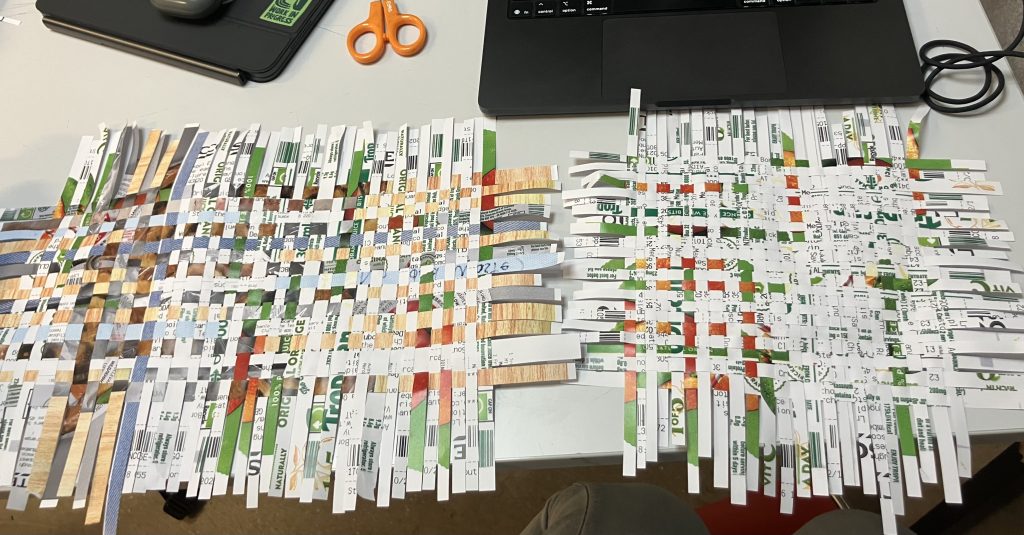
    1. Photocopy all kitchen debris onto the A3 paper
    2. Use a slide cutter to cut paper into long strips, roughly 1cm wide
    3. Weave the paper strips into large sheets, roughly 20cm x 40cm
    4. Use white glue and tape to bind each sheet, then let dry for about 1 hour
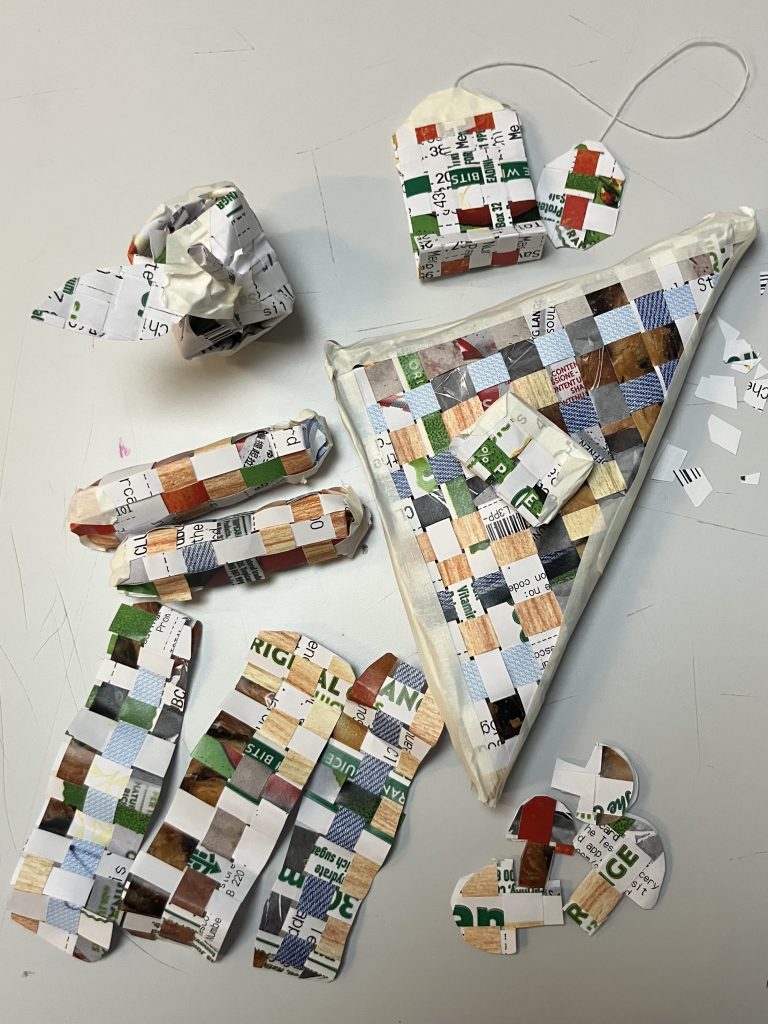
    5. Use a pair of scissors to cut the sheets into the shapes of the following:
      • 1 slice of toast
      • 1 pat of butter
      • 3 strips of bacon
      • 2 sausages
      • 3 mushroom slices
      • 1 apple, stem, and leaf
      • 1 teabag and tag
    6. Assemble items, using tape and string to bind as needed
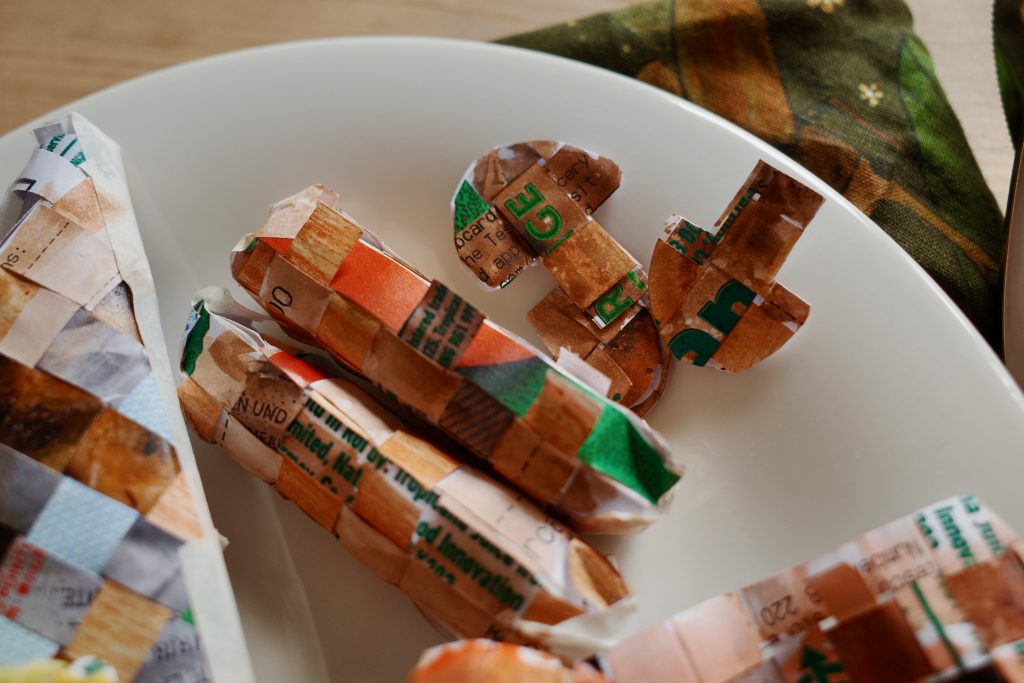
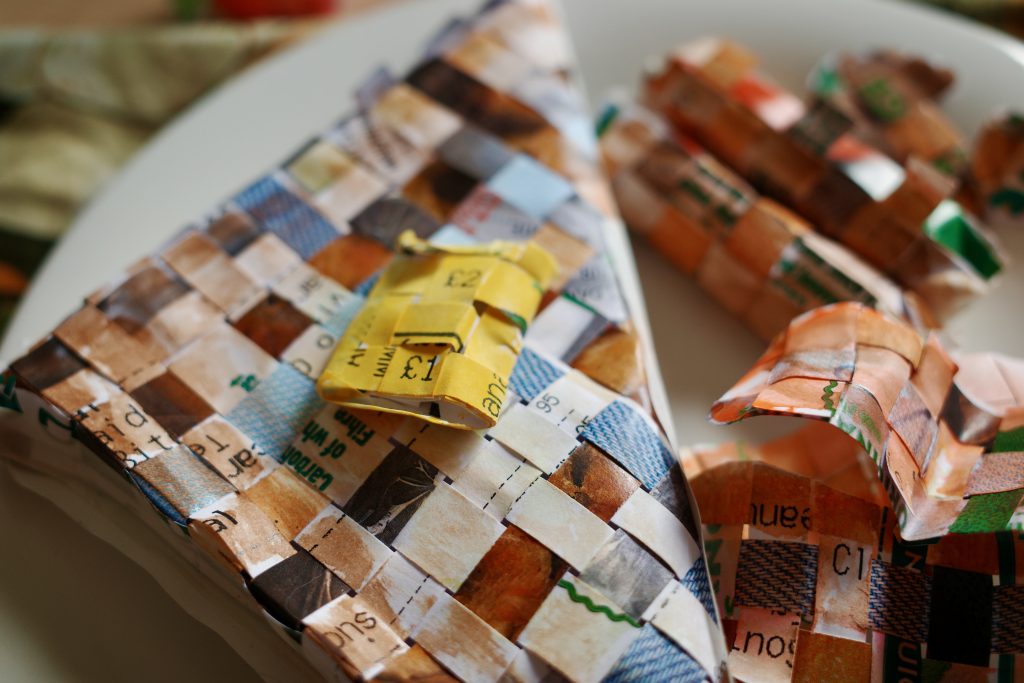
    7. Use the watercolor and brush to paint the items as needed, then let dry for about 30 minutes
    8. Assemble food items on a plate and put the teabag in a cup
    9. Enjoy!

  • Fiber diet: synthetics, microplastics, and the food in our kitchens

    Plastic materials, such as food wrappers, plastic utensils, water bottles, and synthetic textiles, shed plastic particles smaller than 5mm (Bai et al., 2022) — commonly known as microplastics — that do not easily degrade (EFSA CONTAM Panel, 2016). These microplastics contaminate the water supply and agricultural soil, then enter plants and animals that are used as food sources (Lazar et al., 2024). Chandra and Walsh (2024) estimated that microplastics are found in up to 83% of tap water worldwide.

    Today, the question appears not to be whether humans are consuming microplastics, but rather how much. Reports vary wildly, ranging from the alarming figure of 50 plastic bags a year (Bai et al., 2022) to the only slightly less worrying one credit card a week (Gruber et al., 2022), but there is little question that microplastics have already been found present in human bodies (Ragusa et al., 2021; Leslie et al., 2022; Jenner et al., 2022). The full health implications are currently unknown (World Health Organization, 2022).

    About 60% of all fibers used in clothing are plastic-based (Parker et al., 2025), and such textiles shed up to 500,000 tons of microplastics into the ocean per year (European Environment Agency, 2022). Are there synthetic fabrics in the kitchen? In a sense, there might be more than you think.

    For this project, I collected scrap materials from around a household kitchen, such as food packaging, plastic wrappers, receipts, vinyl “wood” veneer, and fabric from clothing. I then scanned and copied these materials onto large sheets of paper, cut them down into thin strips, and hand-wove them into “textiles”. The result is a synthetic material in the literal sense of me artificially combining manmade elements into a whole, but it is also meant to emulate how synthetic fabrics are actually produced: by melting down plastics, extruding them into thin fibers, and knitting them together.

    I used glue and masking tape to bind my “textiles”, then shaped, painted, and plated them like real food and drink. In a very literal way, the synthetic fabrics we make end up on our dinner plates. The cycle is complete.

  • Synthesis and synthetics

    Some types of synthesis and related movements/concepts:

    • Synthetism movement in art — post-Impressionist, synthesizing visual appearance, the artist’s feelings, and aesthetic purity (line/color/form)
    • Synthetic materials — materials artificially extruded to form fibers, then woven into textile
      • Artificial silk first debuted in 1889
      • Commercial process developed in 1894
      • Nylon first developed in 1935, became incredibly popular for women’s stockings
        • Stockings became a symbol of femininity, female sexuality, and fashion (a la Marilyn Monroe)
        • Shoppers swarmed the stores after wartime shortages; at one store in Pittsburgh in 1945, 40k women queued for 13k pairs of stockings and broke into fights (!)
      • Non-biodegradable, can take >200 years to decompose
      • Synthetic garments can release microplastic pollutants during washing
        • Goes into food
    • Synthesis in research — to analyze and combine the work of others to generate new knowledge

    My working definition of synthesis: (breaking down and) recombining component parts into a whole

  • What is research?

    The intentional process of gathering, excavating, and synthesizing knowledge in order to discover new information, which may or may not be what you set out to discover in the first place.

    — Northwest quadrant

  • Kitchen icons classification

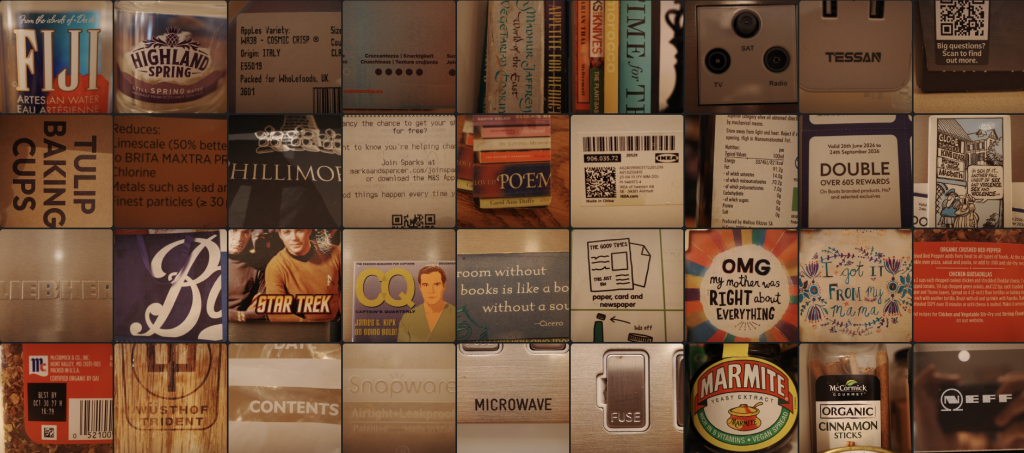
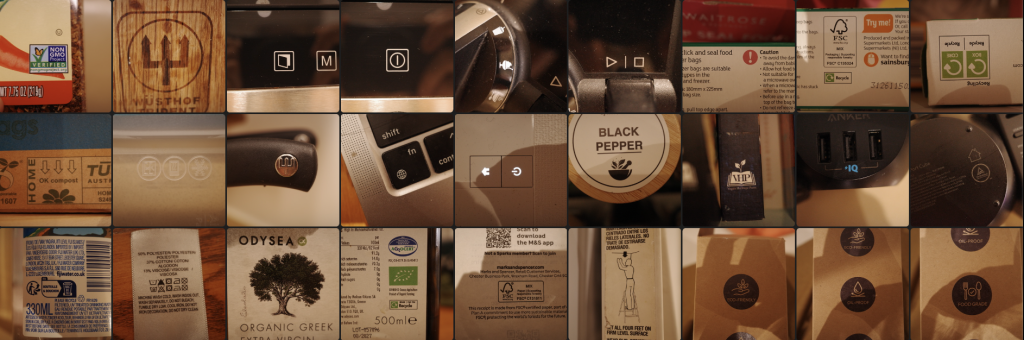
    I started out by photographing text that I saw around the kitchen, with the idea of examining and investigating the typography.

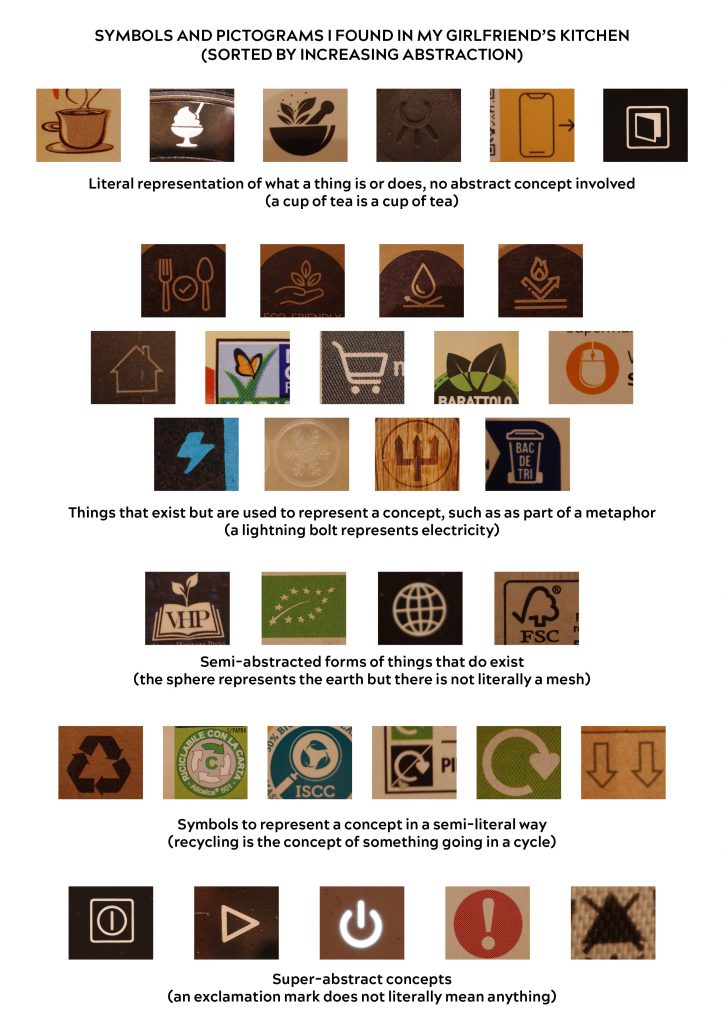
    But as I did this, I realized that the icons accompanying the text seemed much more interesting to me.

    Heavily inspired by Scott McCloud’s Big Triangle, particularly the resemblance <-> meaning axis, I classified some 35 icons, symbols, and pictograms by how literal/representational or abstract/conceptual they seemed to me subjectively.

    During the tutorial with Can, she and I came up with the idea of verbing the icons/symbols somehow — using physical gesture or movement to represent the ideas behind the icons. This is something very intriguing to me and I’ll be thinking and working more on this.

    Some of Can’s recommended reading and viewing for me:

    Additional reading and viewing she suggested in the tutorial session:

  • Methods of investigating project — ideas

    Locations:

    • Tube station platform
    • Supermarket
    • Park bench
    • Crosswalk
    • Bus stop
    • Library

    Things to observe:

    • Languages spoken (aural, recording/notetaking)
    • Heatmap of where people are standing/walking (visual, mapping)
      • Or a map with lines showing routes
      • Projected onto a chess board with moves?
    • Crowd sketches (visual, illustrating)
    • Overheard sentences (aural, recording/notetaking)
      • Typeset into a print thing?
    • Colors spotted (visual, photographing)
      • This could be neat to make a mosaic/collage out of!
    • Typefaces spotted (visual, photographing)
      • …and categorized by style?
    • Brand logos spotted (visual, photographing)
      • …and graphed by revenue?